
How to Train Your Ear to Identify EQ Frequencies
4 min read
Being able to point at a frequency and say “that’s around 3kHz” the moment you hear a problem is one of the highest-leverage skills in mixing. It turns “something sounds off, I’ll sweep an EQ until I find it” into “that’s harsh around 4kHz, I know exactly where to reach.” The second version is faster, more confident, and it’s a learnable skill, not a talent some people just have. This is one specific piece of the broader case for training your ear for mixing in general, zoomed in with a concrete drilling progression.
Why this is worth training deliberately
Most people who mix regularly do eventually develop some frequency intuition, just by trial and error with an EQ sweep. The problem is that this incidental learning is slow and incomplete: you only build recognition for the frequency ranges that happen to cause problems in your own material, and even then, sweeping to find a frequency is a different skill from recognizing it on first listen, without a visual spectrum in front of you.
Isolated drilling, hearing a boost, guessing the frequency, getting instant feedback, closes that gap far faster than incidental exposure ever will.
The anchor-frequency method
Rather than trying to learn the entire spectrum at once, it helps to memorize a small number of “anchor” frequencies first, along with what a boost at each one characteristically sounds like:
- 100-200Hz — boxiness, “mud.” A boost here often sounds like the sound is coming from inside a box.
- 500Hz-1kHz — often described as “honky” or nasal when boosted; this range carries a lot of a sound’s perceived “presence” in a less flattering way.
- 2-4kHz — clarity and attack, but also where harshness starts creeping in. Vocals and snares are especially sensitive here.
- 5-8kHz — brightness and definition; boosted too far, this is where things get fatiguing to listen to.
- 10kHz and up — “air” and sibilance. A boost here adds sheen; too much and “s” sounds start to hiss.
Once these five anchors are solid, in-between frequencies get much easier to estimate, because you’re now interpolating between two known reference points instead of guessing blind.
A drilling progression that actually works
- Start wide and obvious. Use a wide-Q boost (a full octave or more) at a large gain, 6-9dB, at just the five anchor frequencies above. Get comfortable naming all five with high accuracy before moving on.
- Narrow the Q. Keep the gain high but tighten the bandwidth. A narrow-Q boost sounds meaningfully different from a wide one even at the same center frequency and gain, this is worth training as its own skill.
- Reduce the gain. Once wide and narrow boosts are reliable at 6-9dB, drop to 3-4dB, then eventually 1-2dB. This is where real mixing decisions live, and where most people’s training stops too early.
- Add cuts, not just boosts. A cut can be harder to hear than a boost of the same size, since you’re listening for something missing rather than something added. Train it as a separate skill once boosts are solid.
- Randomize. Once each piece is solid individually, drill boosts and cuts, wide and narrow, at random gains and frequencies, no predictable pattern. This is what actually builds real-world recognition speed, since a real mix never tells you in advance what kind of EQ move you’re listening for.
Common mistakes that slow this down
Training only on one type of source material. A boost at 3kHz sounds different on a vocal than on a full drum bus. If you only ever drill on one type of sound, your recognition doesn’t transfer well to everything else you’ll actually mix.
Skipping straight to narrow, low-gain moves. It’s tempting to want to train on “realistic” mixing-level changes right away, but starting there before the coarse skill is solid usually just leads to frustration and guessing, not real learning. Coarse-to-fine is a much faster path than jumping straight to fine.
Not tracking accuracy by frequency range. Most people are meaningfully better at some parts of the spectrum than others (commonly weaker in the 500Hz-2kHz “mud/honk” zone, since it’s less obviously pleasant or unpleasant than the extremes). Without tracking accuracy per range, that gap can persist indefinitely without you noticing it.
If you’re working through this progression and still missing changes that should be audible at your current stage, it’s worth ruling out a setup or monitoring issue before assuming it’s purely a skill gap, see Why Can’t I Hear EQ Changes in My Mix? for the most common causes.
How long this actually takes
Reliable recognition of the five wide anchor frequencies at high gain typically comes within the first handful of short sessions. Narrow-Q, low-gain discrimination across the full spectrum, the level that actually changes how you mix, takes weeks of regular short practice rather than days. That’s a realistic timeline, not a discouraging one: every session moves the needle, and unlike most skills, the payoff shows up directly in every mix you touch afterward.
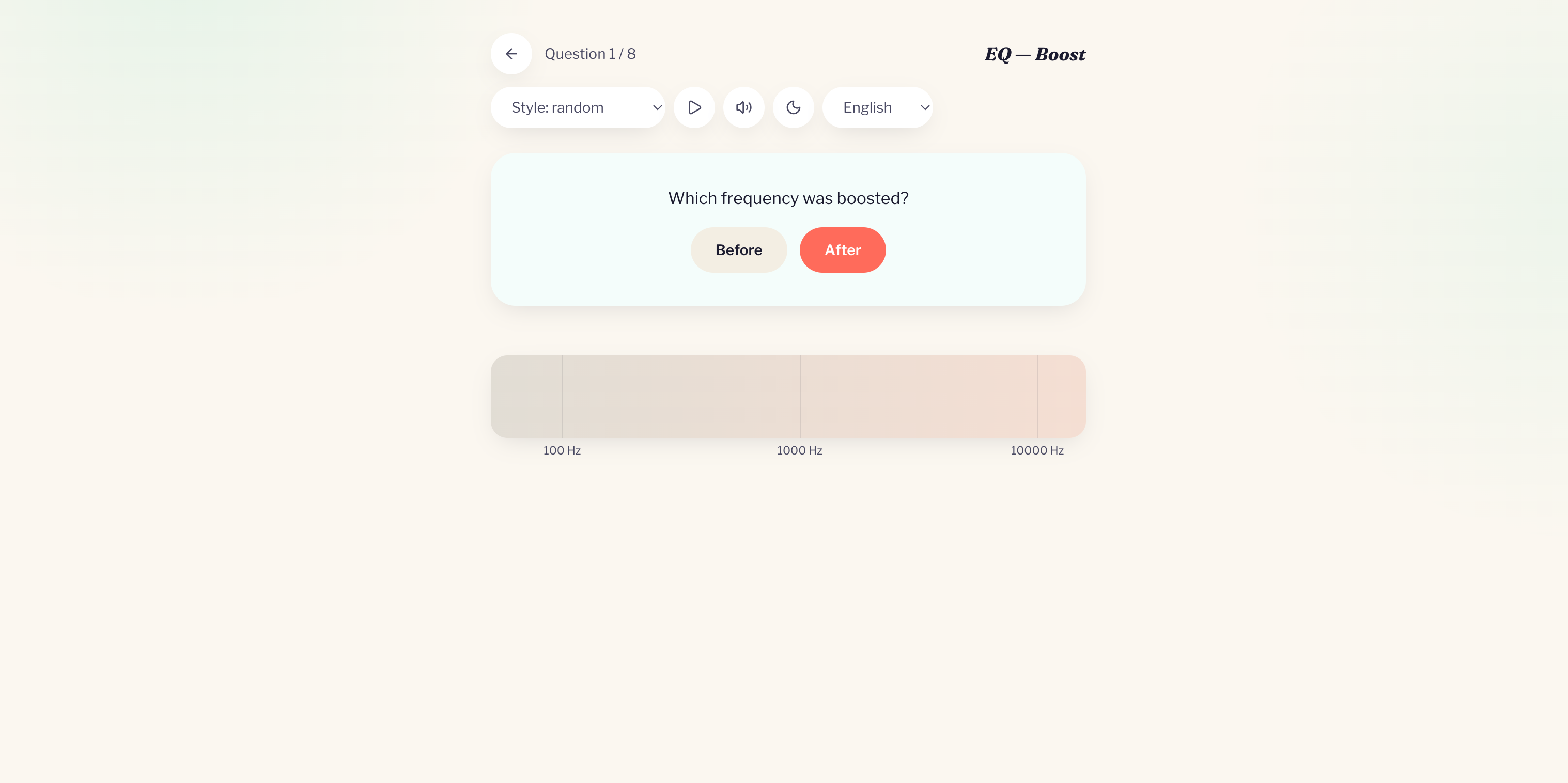
Earlytics has a dedicated EQ Boost and EQ Cut category built around exactly this kind of progressive drilling, with difficulty that adjusts automatically as your accuracy improves. Free to start, no card required.