
How to Train Your Ear for Mixing (EQ, Compression, and Beyond)
8 min read
Most musicians who go through ear training spend years on intervals, chords, and scales, and can name a major seventh by ear without thinking twice. Ask the same person to identify a 3dB boost at 2kHz, or tell a 4:1 compression ratio from an 8:1, and most go quiet. It’s not that mixing is inherently harder to hear than harmony. It’s that almost nobody trains for it the same deliberate way.
This isn’t a small gap. Mixing is arguably a more common daily task than sight-singing an interval for most producers, yet the ear-training tradition built around solfège, hundreds of years of pedagogy, structured drills, graded difficulty, has almost never been applied to it. This article looks at why that gap exists, which mixing skills actually respond to isolated ear training, and how to build a practice routine that works.
Why mixing skills don’t “just happen” with experience
The usual path is: mix a lot of tracks, get feedback, slowly build intuition. That works, eventually, but it’s slow and inconsistent for two reasons.
You only train on whatever problems your current projects happen to have. If you never had a session with harsh sibilance, you never built an ear for it. If every vocal you’ve mixed so far has been recorded in a treated room, you have no reference for what a bad room sounds like on tape, and you’ll miss it the first time it matters. Real-world mixing exposes you to a random sample of problems, not a representative one.
Feedback is slow and indirect. In a real mix, you make a decision, move on, and might not find out it was wrong until a client, a mastering engineer, or your own ears three weeks later flag it. Compare that to solfège: you hear an interval, guess, and know if you’re right within a second. That tight feedback loop is a huge part of why solfège training works as well as it does, and it’s almost entirely absent from how people learn to mix.
Solfège training solved both problems decades ago with structured, isolated drills: hear an interval, name it, get instant feedback, repeat until it’s automatic, then increase the difficulty once you’re consistently right. Mixing skills respond to the exact same method. The reason it’s rarely done this way isn’t that it wouldn’t work, it’s that almost no tool has actually offered it.
The skills worth training specifically
Not every mixing decision is a good candidate for ear-training drills. Skills that are highly contextual (arrangement decisions, creative reverb choices) don’t isolate well. Skills that are about recognizing a specific, repeatable sonic signature do. A handful of areas respond especially well to isolated, drilled practice:
EQ recognition
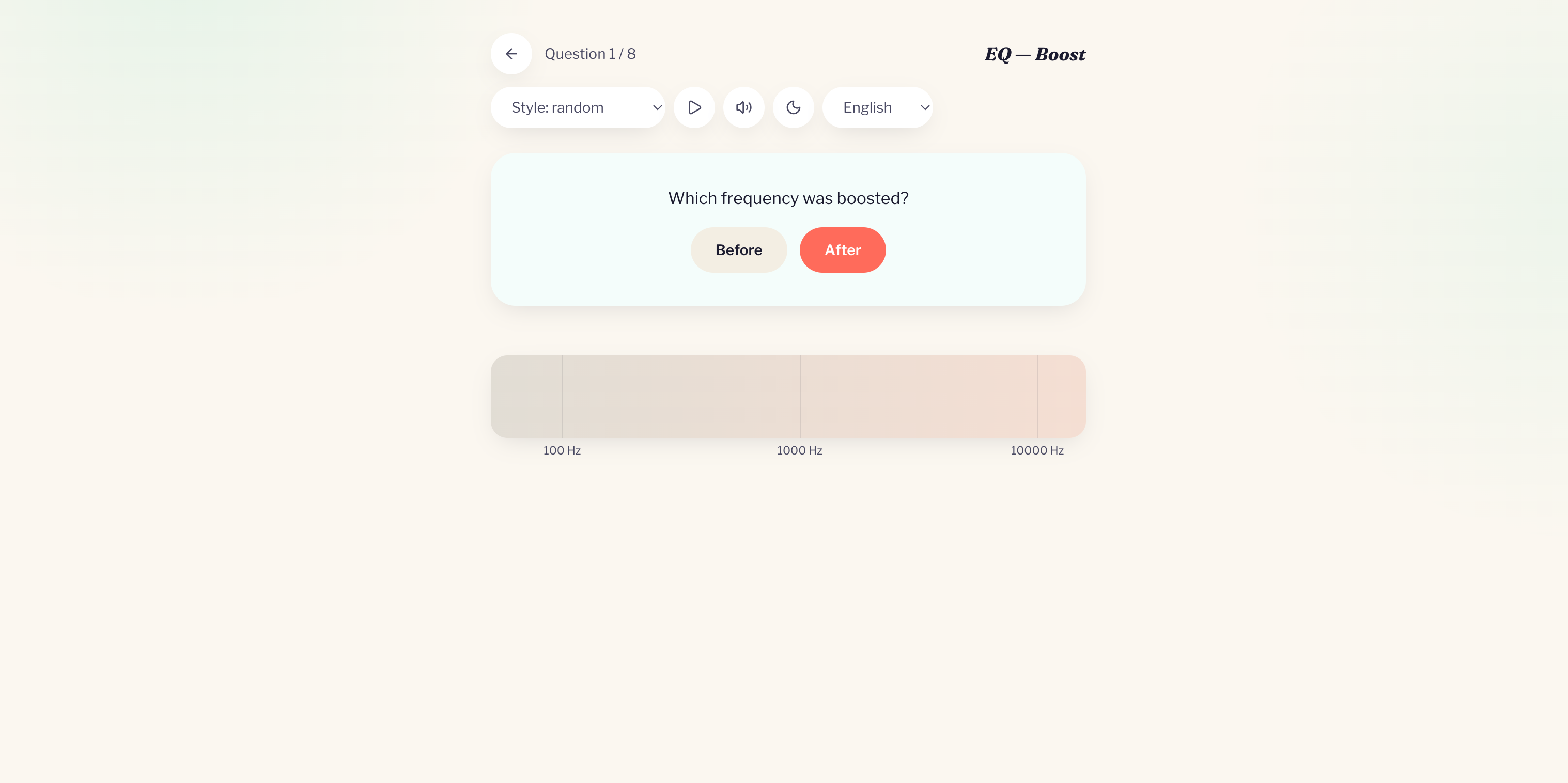
This is the foundation. The goal is twofold: hearing that a frequency range has been boosted or cut, and estimating roughly where. In practice this splits into two separate skills that are worth training separately before combining them:
- Detecting the change at all. Some boosts and cuts are subtle enough that on an untrained ear they just sound like “a bit different” rather than clearly identifiable as EQ. Training starts with obvious, wide-Q boosts and cuts, and narrows from there.
- Localizing it on the spectrum. Once you can hear that something changed, the next skill is placing it: is that boost around 200Hz (boxy/muddy), 3-5kHz (presence, can turn harsh fast), or 10kHz+ (air, sibilance)? This is where most of the practical value is, since it tells you exactly where to reach for a fix.
A good drill progression: start with large boosts/cuts (6dB+) at a handful of anchor frequencies, get comfortable naming them, then narrow both the gain (down to 2-3dB) and widen the frequency options as accuracy improves. For the full breakdown, including specific anchor frequencies and common mistakes, see How to Train Your Ear to Identify EQ Frequencies.
If you’re finding it hard to hear even large, obvious changes, that’s worth troubleshooting separately, see Why Can’t I Hear EQ Changes in My Mix? for the most common causes before assuming it’s purely a training gap.
Compression
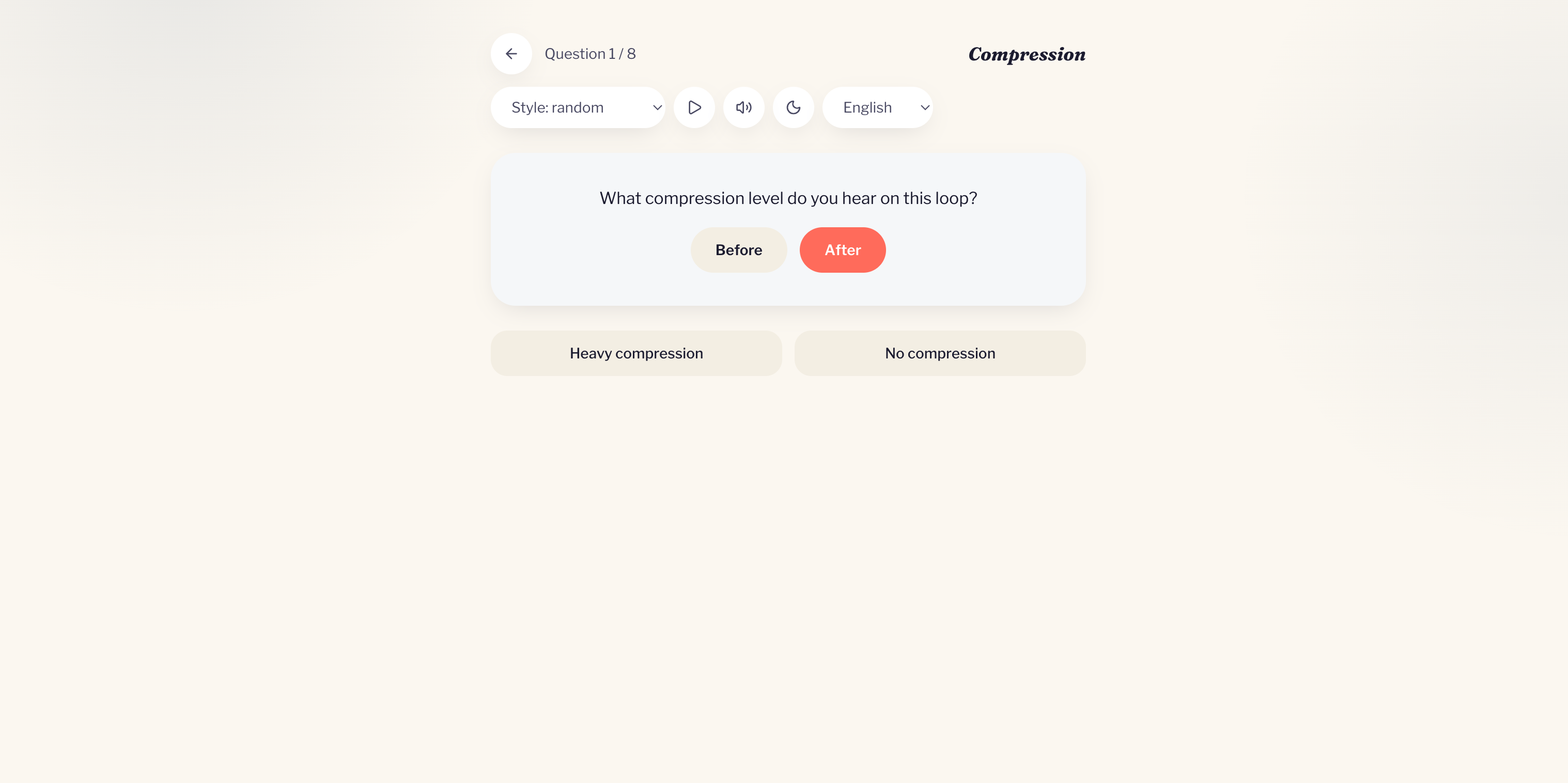
Compression is harder to train than EQ because it changes dynamics over time, not a static spectral shape, so there’s more to listen for at once. Three things are worth separating:
- Whether compression is present at all, and roughly how much gain reduction is happening.
- Ratio. A 2:1 and an 8:1 sound meaningfully different even at the same amount of gain reduction, the higher ratio is more aggressive about clamping down once the threshold is crossed, and that character is learnable.
- Attack and release, independently. A fast attack tames transients (can make a drum sound squashed or lifeless); a slow attack lets the transient through before compression kicks in (often used to preserve punch). Release time affects how audibly the compressor “breathes” or pumps.
These interact, which is part of what makes compression hard to learn from real mixing alone: you rarely get to change just one variable and A/B it cleanly on a real session under deadline. Isolated drills that hold everything else constant and vary one parameter at a time are much more efficient here than incidental exposure. See Compression Ear Training: How to Hear Ratio, Attack, and Release for a full drilling progression on each variable.
Saturation and harmonic distortion
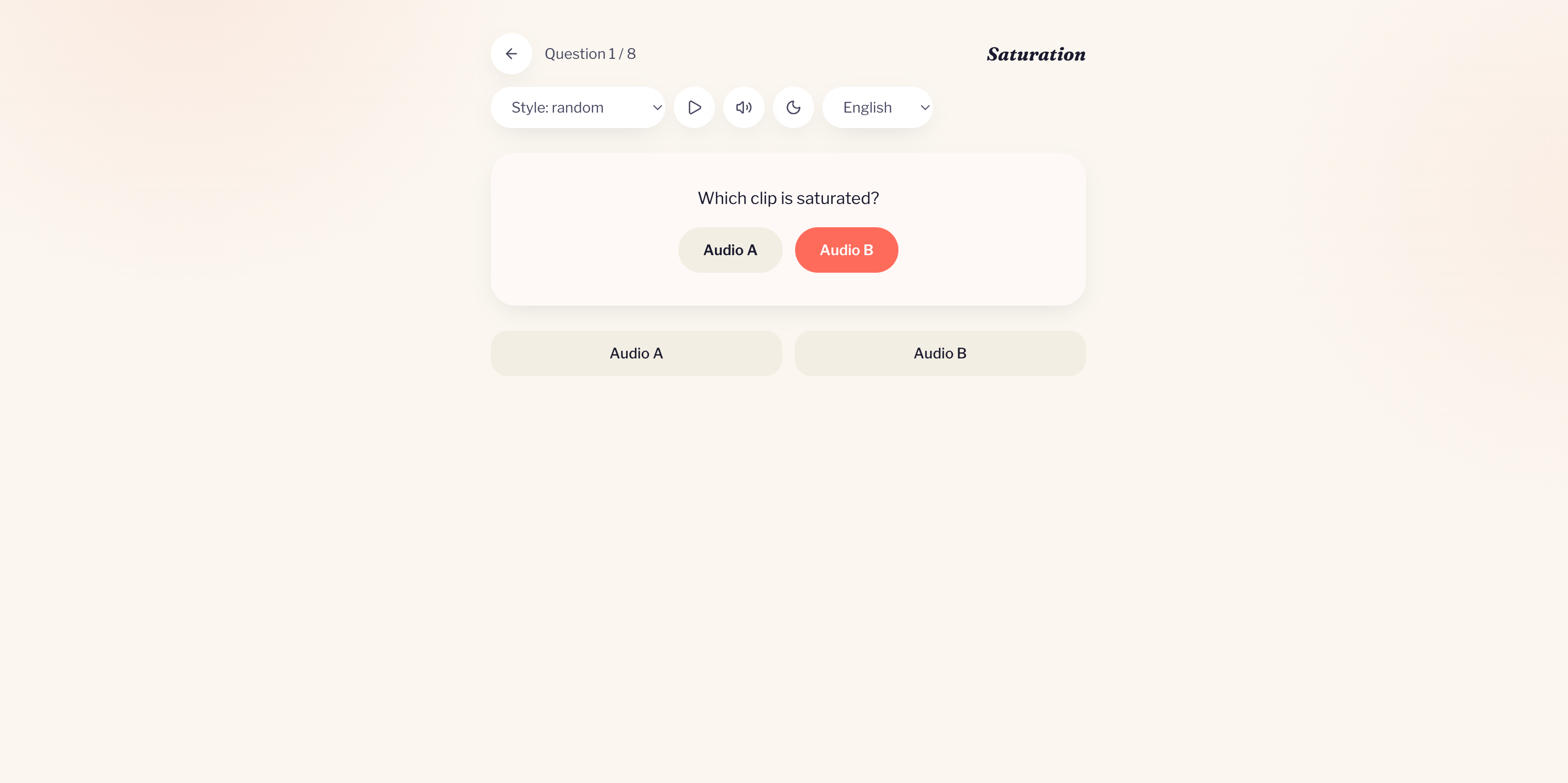
Saturation adds harmonics, and in small amounts it reads as “warmth” or “character” rather than obvious distortion, which is exactly what makes it hard to hear at first. The skill worth building is catching it before it becomes obviously “crunchy”: recognizing the early signs of added harmonic content on a signal that otherwise sounds clean. This matters practically because by the time saturation is obvious, it’s often already too much for the mix. See How to Recognize Saturation and Distortion by Ear for a full drilling progression.
Panning and stereo width
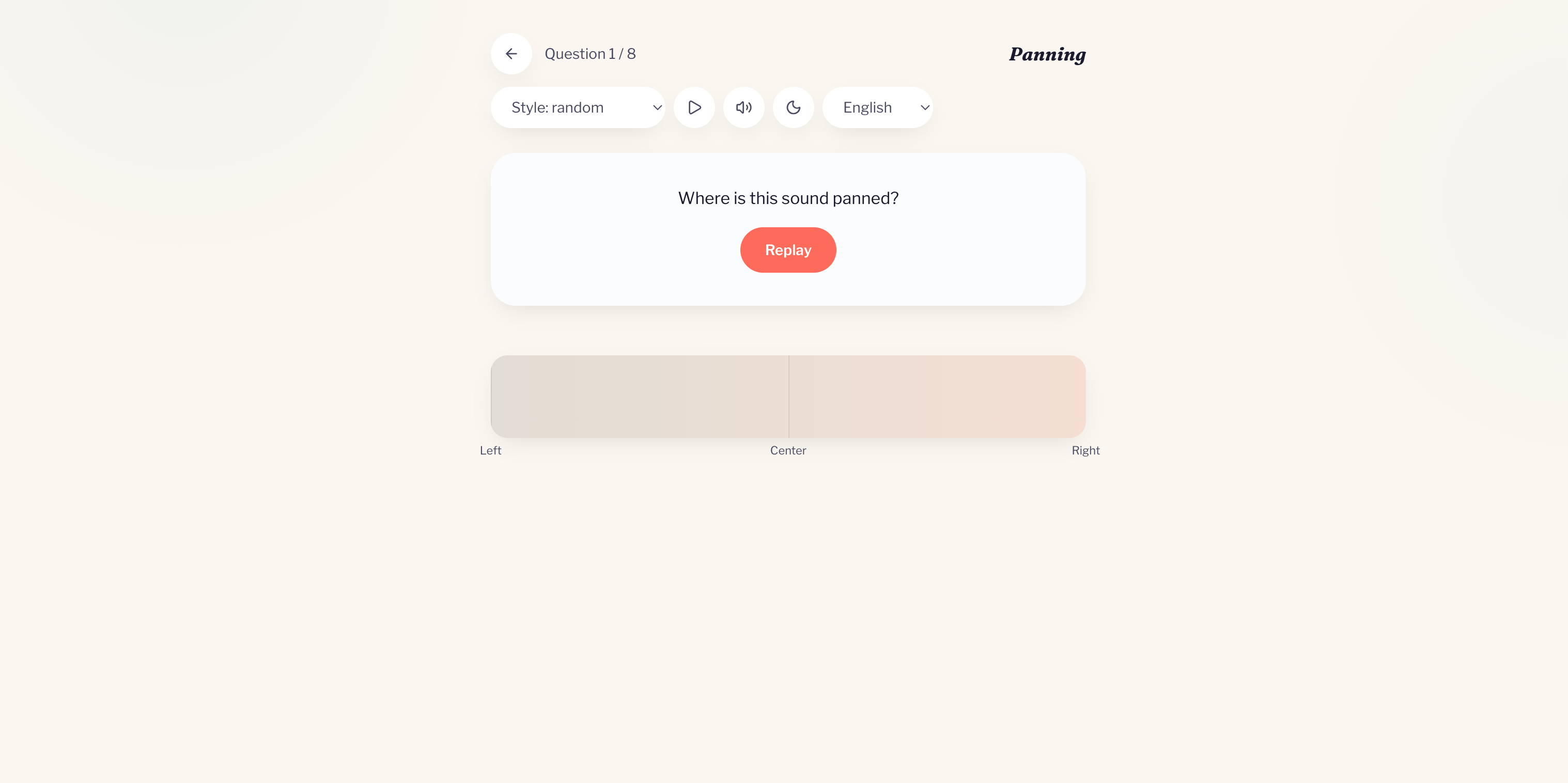
This category is unusually easy to fool yourself on. Judgments made on headphones often don’t hold up on monitors, and vice versa, because the two rely on different physical and psychoacoustic cues for stereo image. Training panning position and stereo width recognition in isolation, with instant right/wrong feedback, builds a more reliable internal reference than casually A/B-ing on whatever playback system happens to be nearby. See Panning and Stereo Width: Ear Training Exercises for Better Placement for a dedicated drilling progression.
Reverb
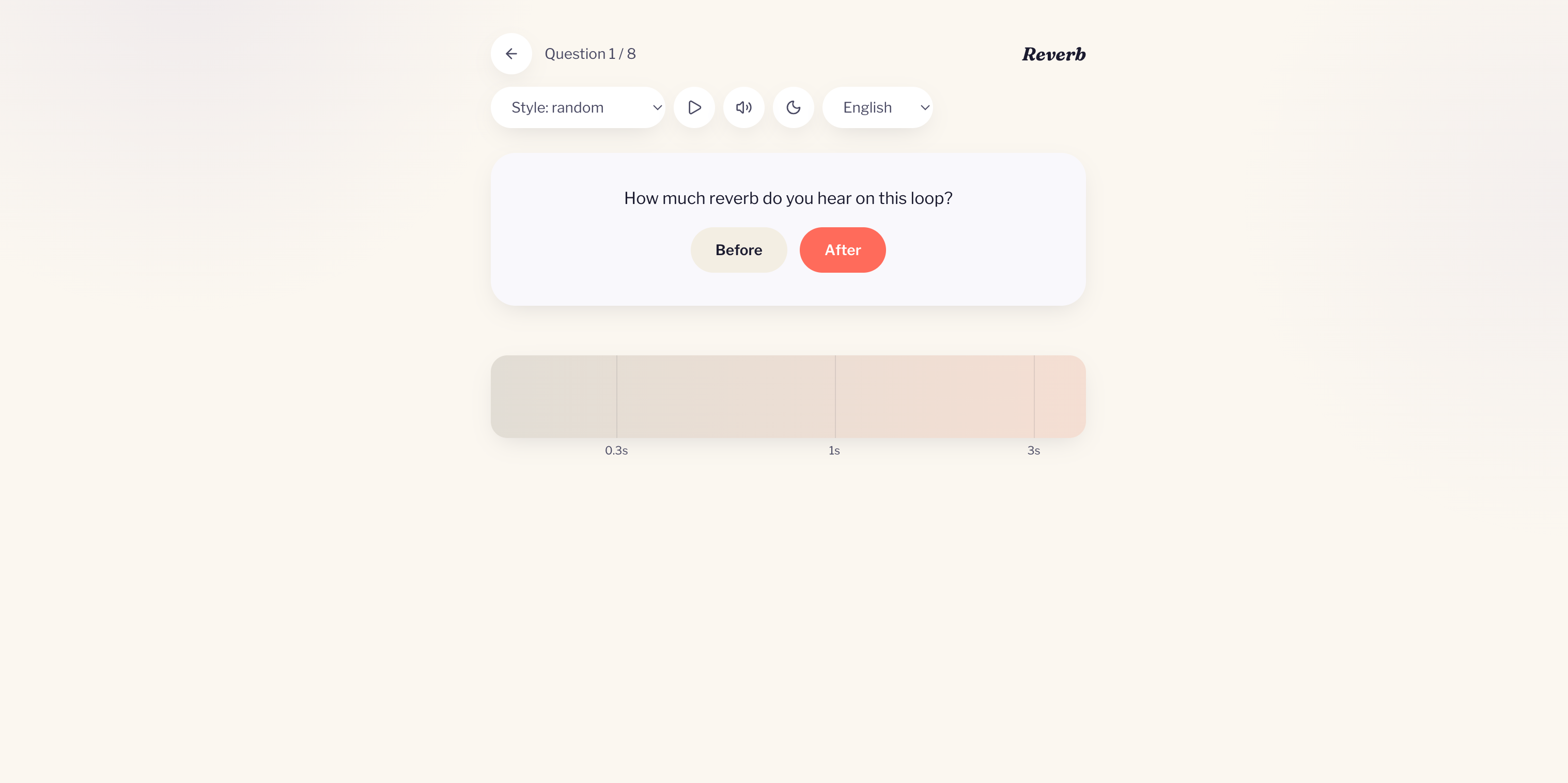
The two variables worth training separately are room size (small room vs. large hall) and decay time (how long the tail lasts). Both are frequently confused with each other by ear until you’ve specifically drilled telling them apart, a short reverb on a small room and a long reverb on a small room can sound surprisingly similar out of context, and the same is true at the large end. The reverb ear training guide breaks down decay, room size and pre-delay with a step-by-step drill.
Making practice actually stick
Beyond picking the right skills to drill, a few structural things determine whether ear training for mixing actually works or just feels like a nice idea that fizzles out after a week.
1. Difficulty has to track your real level, per skill. Practicing at a fixed difficulty either bores you once you’ve improved (and you stop paying real attention), or stays too hard and kills motivation before the skill sets in. Critically, this needs to happen per category: someone might be quite advanced at EQ recognition but a beginner at compression ratio, and a single overall “level” setting doesn’t capture that.
2. Short, frequent sessions beat long occasional ones. Ten focused minutes most days builds recognition speed faster than an hour once a week. This mirrors what’s well established in solfège and language-learning research: spaced repetition beats cramming for building fast, automatic recognition rather than slow, effortful reasoning.
3. Immediate feedback is what makes it “training” instead of just listening. Passive listening, even attentive, critical listening, doesn’t build the same recognition speed as active guessing with instant right/wrong feedback. The guess-then-verify loop is what actually rewires the automatic response; listening alone mostly reinforces whatever level you’re already at.
4. Track progress by category, not just overall. Knowing that you’re strong on EQ but weak on compression attack/release tells you exactly where to focus next session. A single aggregate score hides that and makes practice time less efficient than it could be.
Realistic expectations
This kind of ear training compounds, but not instantly. Coarse discrimination (a big, obvious 8dB boost vs. no boost) typically comes fast, often within the first few sessions. Fine discrimination (2-3dB, narrow-Q) and the more subjective categories like saturation and reverb character take longer, weeks of regular short sessions rather than days. That timeline is consistent with what’s observed in solfège training too: intervals get easy quickly, but distinguishing close chord voicings by ear takes sustained practice. There’s no shortcut around repetition here, but the return on that repetition is real and, unlike a lot of study, directly reflected in every mix you make afterward.
Where to actually do this
This is exactly the gap Earlytics was built to close: classic solfège training (intervals, chords, scales, rhythm, cadences) alongside dedicated mixing categories (EQ boost/cut, compression, compression ratio, compression attack/release, saturation, panning, volume gap, filtering, reverb, stereo width, and frequency matching), with difficulty that adjusts automatically per category as you improve, rather than one flat setting for everything. It’s free to start, no card required, generous enough to get a real sense of whether the method works for you before committing to anything. See how it compares to other ear-training apps if you’re weighing it against something you’re already using.