
Panning and Stereo Width: Ear Training Exercises for Better Placement
4 min read
Panning and stereo width feel like the simplest thing to judge by ear, a sound is either centered or it isn’t, wide or narrow. In practice they’re some of the easiest decisions to get wrong, because the judgment depends heavily on what you’re listening on. A placement that reads as clearly off-center on headphones can sound nearly centered on speakers, and a mix that feels comfortably wide in one room can collapse or phase out in another. Getting reliable at this specific skill means training a reference that holds up across playback systems, not just trusting whatever you hear in the moment.
This is one piece of the broader case for training your ear for mixing, zoomed in on panning position and stereo width specifically.
Two different skills, often confused
Panning and stereo width get lumped together because they’re both about the stereo field, but they’re testing different things.
Panning position is about where a sound sits on the left-to-right axis, mostly driven by level differences between the two channels (and, for real sound sources rather than panned mono signals, small timing differences too). The skill is judging where something is placed.
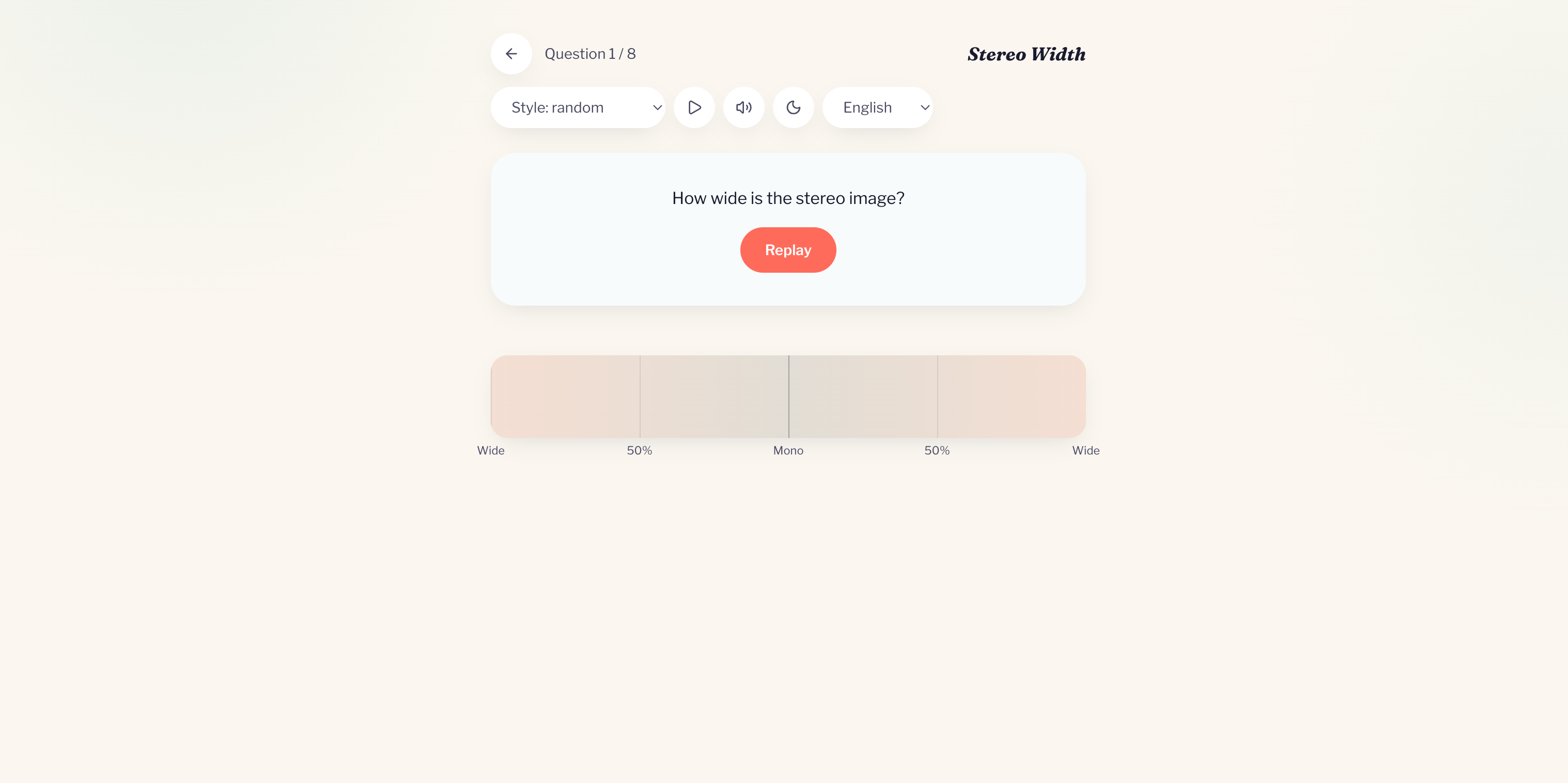
Stereo width is about how wide or narrow a sound feels, driven by how correlated the left and right channels are. A fully mono signal has zero width. A wide signal has meaningfully different content between the channels, achieved through techniques like decorrelation, mid-side processing, or genuinely separate stereo recording. The skill here is judging how spread out something is, independent of where its center sits.
Why headphones and speakers disagree
This is the part that trips people up most. Headphones deliver each channel directly to each ear with no crossfeed, so panning cues (especially level-based ones) read as very pronounced, sometimes exaggeratedly so. Speakers involve crossfeed (each ear hears some of both channels) and the room itself, which softens panning extremes and changes how width is perceived. A mix that sounds hard-panned and wide on headphones can feel noticeably more centered and narrower on speakers, and vice versa for judgments made the other way around.
Neither playback system is “wrong,” they’re just different physical situations. The practical implication is that a panning or width judgment trained and checked on only one system doesn’t transfer reliably. Building the skill on both, and specifically noticing where they disagree, is what makes the internal reference actually useful.
A drilling progression that builds this specifically
1. Start with extremes. For panning, train hard left versus hard right versus dead center first, these are unambiguous and let you build initial confidence in the skill of localizing at all. For width, train fully mono versus obviously wide (a stereo synth pad or a decorrelated pair works well) before anything subtler.
2. Narrow the gap in stages. Move panning judgments from the extremes toward positions closer to center, quarter-left, an eighth off-center, and so on. Move width judgments from “obviously wide” toward “barely wider than mono.” This is the same coarse-to-fine structure that works for EQ recognition and saturation: build the skill on unmistakable cases before asking it to work on subtle ones.
3. Cross-check across playback systems deliberately. Once a judgment feels reliable on one system, repeat it on the other (headphones if you started on speakers, or vice versa) and notice specifically where the two disagree. That disagreement is data, not a failure, it’s telling you which judgments are robust and which are playback-dependent.
4. Practice on full mixes, not just isolated tones. Panning and width judgments on a single instrument are a good starting point, but the skill that actually matters is judging placement and spread within a busy arrangement, where masking and psychoacoustic interactions between elements change what’s actually perceivable.
The mono compatibility trap
A specific, practical reason this skill matters beyond aesthetics: stereo width techniques that rely on heavy channel decorrelation or out-of-phase content can sound impressively wide in stereo and then partially or fully cancel out when played back in mono, still common on phone speakers, some club and venue systems, and broadcast. A trained ear for width includes noticing when a wide effect is built on genuinely new stereo content (safe) versus phase tricks that won’t survive a mono fold-down (risky). This isn’t something you can judge by eye on a meter alone, it’s a listening skill.
Why this matters practically
Once panning and width judgments hold up across playback systems, mixing decisions stop being guesswork based on whatever room or headphones happen to be nearby. You can place elements with confidence that the arrangement will translate, and build width that adds genuine spaciousness rather than width that disappears (or causes problems) the moment someone listens on a different system than you mixed on.
Earlytics has dedicated categories for both panning position and stereo width, the width exercise specifically trained as distance from mono rather than a left-to-right point, so both directions from center count equally. Difficulty adjusts automatically as your accuracy improves. Free to start, no card required.