Quiztones Alternative: Ear Training Beyond EQ
4 min read
Quiztones is one of the classic EQ ear training apps: quick quizzes on frequencies, EQ boosts and cuts, and gain changes, in a polished native app. People usually look for an alternative for one of two reasons: they want to train more than EQ, or they’re not on an iPhone or a Mac. Here’s an honest comparison.
Full disclosure: Earlytics is our app. Details below were checked on each site in September 2026.
What Quiztones does well
Quiztones does one thing and does it well: frequency ear training.
- Four quiz types: Tone, EQ, Gain, and a Practice mode
- 450+ quizzes with progressive difficulty, up to third-octave precision
- Your own audio: you can import your own tracks to train on material you know
- Premium loops across instruments and genres
- Native apps for iPhone and Mac, with a long track record (hundreds of thousands of downloads)
It’s also deliberately “ears only”: the training avoids visual cues, which is the right instinct for this kind of practice. If EQ is the single skill you want to drill and you’re on Apple devices, it’s a solid, focused choice.
Where people run into limits
It’s EQ-focused. Tones, EQ moves and gain changes are covered. Compression, attack and release, saturation, panning, stereo width and reverb are not.
Apple only. Quiztones runs on iPhone and Mac. There’s no Android or Windows version.
No music theory side. Intervals, chords and scales aren’t part of it, which is fine for an EQ tool but means a second app if you want both.
How Earlytics is different
Earlytics covers the whole mixing chain, plus the solfège fundamentals, in one place:
- EQ boost and EQ cut trained separately (cuts are much harder to hear than boosts, so they deserve their own track)
- Compression in three dimensions: amount, ratio, and attack/release
- Saturation, panning, stereo width, volume gaps, filters, reverb and frequency matching
- Solfège: intervals, chords, scales, rhythm dictation and cadences
Each of the 17 categories has 10 levels that adapt to your accuracy. The EQ tiers get narrower and subtler as you improve: at level 1 a cut is 14 dB deep and wide, by level 10 it’s a 3 dB notch.
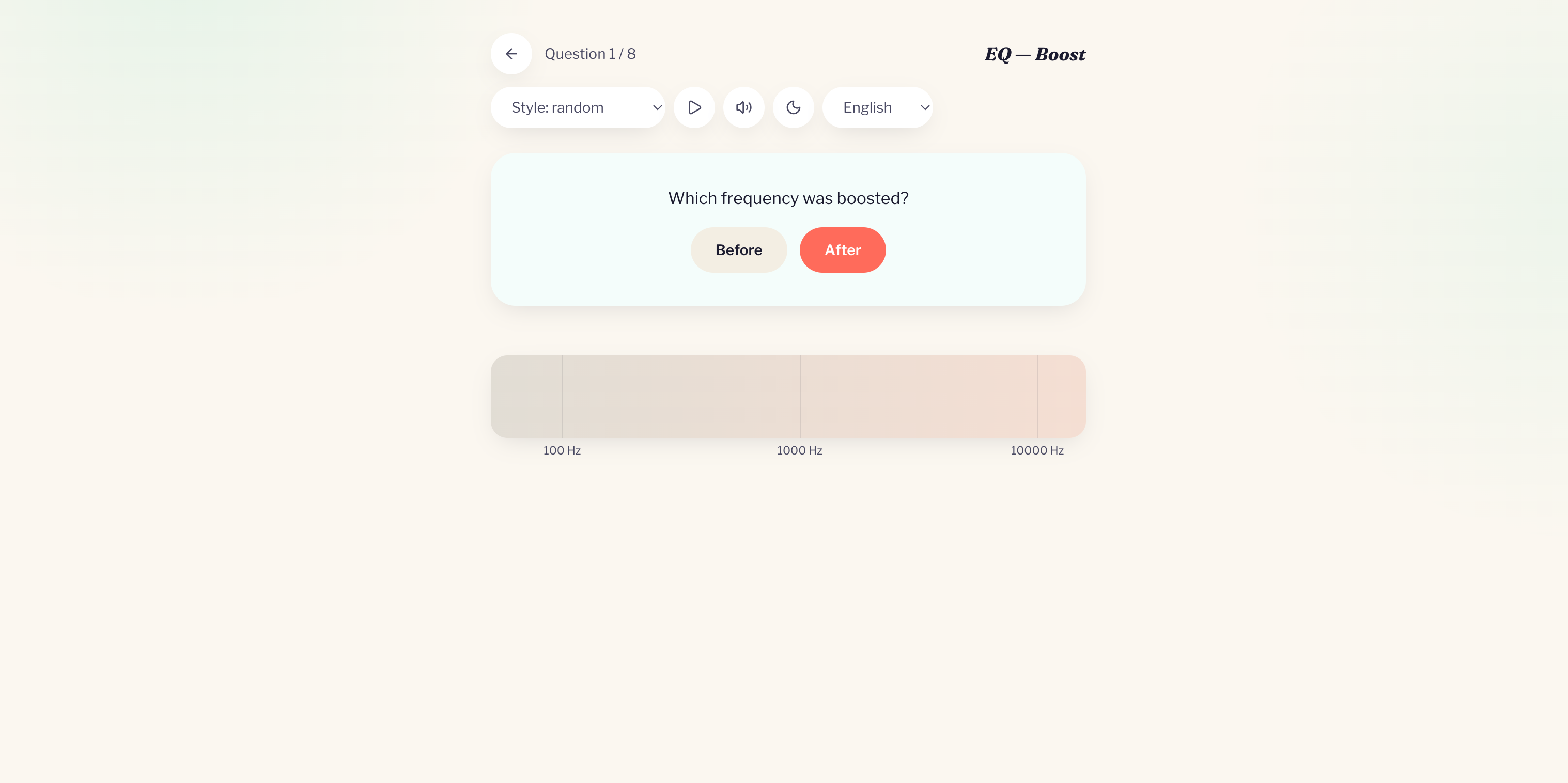
It runs in any browser (Windows, Android, Linux, Mac, iPhone) and installs on a phone’s home screen like an app. The free plan gives you 8 questions per month in every category, and paid plans are €4.99 per month, €39.99 per year or €59.99 lifetime.
Side by side
| Quiztones | Earlytics | |
|---|---|---|
| EQ / frequency training | Yes, the core focus | Yes (EQ boost, EQ cut, frequency matching) |
| Compression, saturation, panning, width, reverb | No | Yes |
| Solfège | No | Yes (5 categories) |
| Import your own tracks | Yes | No, built-in loops |
| Platforms | iPhone, Mac | Any browser, installable on phone |
| Free to start | Yes | Yes, all 17 categories |
Where Quiztones is still the better pick
- You want to train EQ on your own mixes and stems. Importing your own audio is a real advantage for learning the specific material you work on, and Earlytics doesn’t offer it.
- You only care about EQ and prefer a native Apple app.
Where Earlytics is the better pick
- You want to go beyond EQ: compression is usually the next wall producers hit, and it has three separate variables to learn (see our compression ear training guide)
- You’re on Android or Windows
- You want mixing and solfège training tracked in one place, skill by skill
A quick way to decide
Most producers get reasonably good at EQ first and then discover that compression, saturation and reverb are where their ear is actually untrained. If that sounds familiar, try the free 2-minute Earlytics test: six questions across EQ, panning and compression, no account needed, and you’ll see where your ear stands on each.
For the method side, whatever tool you use, the EQ frequency guide walks through how to build frequency recognition step by step, and our wider app comparison covers EarMaster and Perfect Ear too.