Best Ear Training Apps for Music Producers, Compared
4 min read
Most “best ear training app” roundups compare tools that are, underneath the branding, doing the same thing: interval, chord, and scale recognition drills descended from classical solfège training. That’s genuinely useful, but it leaves a gap for anyone whose daily work is mixing rather than performance or composition (see why that gap exists and what to do about it for the longer version). Here’s an honest look at where the well-known options focus, and where a producer specifically should look.
What to actually look for
Before comparing specific apps, it’s worth being clear about what matters:
- Does difficulty adapt automatically? A fixed difficulty level either stays too easy once you’ve improved, or too hard before you’re ready, in both cases you stop learning efficiently.
- Does it track progress per skill, not just overall? Being “level 5” in general tells you nothing about which specific skills are still weak.
- Does the content match what you actually do day to day? This is the big divider below.
EarMaster
EarMaster is one of the longest-running names in ear training software, widely used in music schools and conservatories. Its strength is breadth and depth on the classical fundamentals: intervals, chords, scales, rhythm dictation, and sight-singing, with a long track record and a structured curriculum feel. If your goal is a thorough grounding in traditional solfège, it’s a serious, well-built option.
What it doesn’t cover is anything related to mixing or production, EQ, compression, saturation, and the like simply aren’t part of its scope. That’s not a flaw, it was built for a different purpose, but it means a producer looking specifically to train those skills won’t find them here.
Perfect Ear
Perfect Ear covers similar fundamental ground to EarMaster, intervals, chords, scales, rhythm, in a more casual, mobile-first, gamified package. It’s a solid, approachable choice if you want fundamentals training that doesn’t feel like homework.
Like EarMaster, its scope is squarely classical/theory fundamentals rather than production skills, so the same gap applies for anyone whose main use case is mixing.
Quiztones
Quiztones takes a different approach: rather than solfège fundamentals, it’s built specifically around EQ frequency recognition, built by a working mixing engineer for exactly that purpose. If EQ ear training is the one thing you want to drill, it’s a focused, purpose-built tool for it (see our own breakdown of how to drill EQ recognition if you’d rather work through the method yourself).
Its focus is also its main limitation for some users: it’s specifically about EQ, so if you also want to train compression, saturation, panning, or reverb recognition, or classical fundamentals alongside it, you’d need a separate tool for each.
Looking at one of these tools specifically? We also wrote dedicated, side-by-side comparisons: SoundGym alternative, Quiztones alternative and TrainYourEars alternative.
Where Earlytics fits
Earlytics was built to close the specific gap above: one app covering both classical solfège (intervals, chords, scales, rhythm, cadences) and a full set of mixing-specific categories, EQ boost/cut, compression (with ratio and attack/release trained separately), saturation, panning, stereo width, reverb, and a few others, with difficulty that adjusts automatically per category rather than one flat setting for everything.
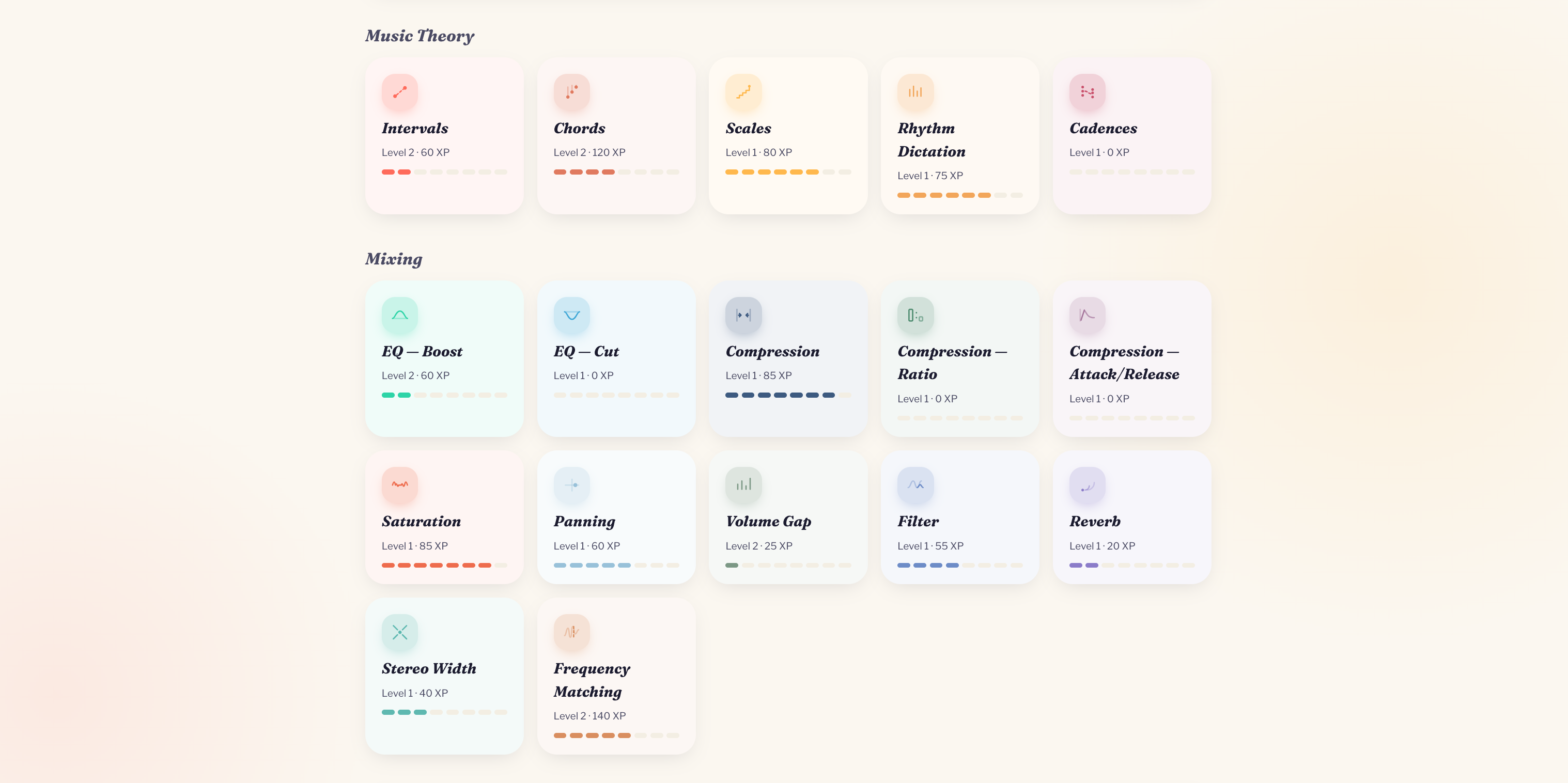
The trade-off is the flip side of that breadth: it’s newer than EarMaster or Perfect Ear, without their decades of track record, and its solfège content, while genuinely covering the fundamentals, isn’t as exhaustively deep as a dedicated classical ear-training tool built for conservatory-level sight-singing.
The honest recommendation
If you’re a performer or composer and your goal is purely classical ear training, EarMaster or Perfect Ear are mature, well-built choices and there’s no strong reason to look elsewhere. If EQ recognition is specifically the one skill you want to drill in isolation, Quiztones is a focused tool built for exactly that.
If you’re a producer who wants both, the classical fundamentals and the mixing-specific skills, in one place, with adaptive difficulty tracked separately per skill, that’s the specific gap Earlytics is built to fill. It’s free to start, no card required, so it costs nothing to see which approach actually fits how you work.